
Keywords
How to Cite
Abstract
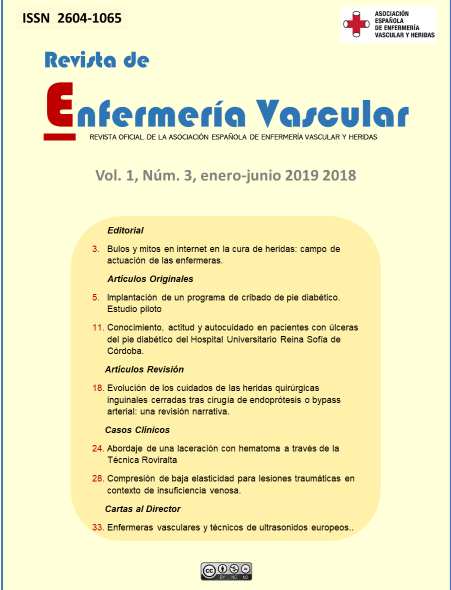
Closed inguinal surgical wounds are especially important due to their particular tendency to infection after bypass and arterial stent surgeries. The postoperative complications are accentuated especially in people with difficulties with elimination and / or with different commodities. Negative pressure therapy is one of the alternatives recently considered for the prevention of infection of vascular surgical wounds of inguinal origin. We proposed to review the existing evidence about the use of negative pressure therapy in the prevention of infections of the inguinal surgical incisions during the postoperative period of vascular surgery. The bibliographic bases used were Medline, Cinhal and Embase. Eight articles were obtained, three of which are dedicated exclusively to the inguinal approach. There are few experimental and quality studies specifically dedicated to evaluating the efficacy of negative pressure therapy in the prevention of infections in inguinal surgical wounds versus other types of cures.
References
Andersson S, Monsen C, Acosta S. Outcome and complications using negative pressure wound therapy in the groin for perivascular surgical site infections after vascular surgery. Annals of Vascular Surgery .2018; 48: 104-110. doi:10.1016/j.avsg.2017.10.018.
Bandyk DF. Vascular surgical site infection: risk factors and preventive measures. Seminars in Vascular Surgery. 2008; 21(3):119–123.https://doi.org/10.1053/j.semvascsurg.2008.05.008.
De Lissovoy G, Fraeman K, Hutchins V, Murphy D, Song D, Vaughn BB. Surgical site infection: incidence and impact on hospital utilization and treatment costs. Am J Infect Control. 2009; 37(5):387-397. https://doi.org/10.1016/j.ajic.2008.12.010.
Díaz-Agero-Pérez C, Pita-López MJ, Robustillo-Rodela A, Figuerola-Tejerina A, Monge-Jodrá V, Grupo de Trabajo INCLIMECC de la Comunidad de Madrid. Evaluación de la infección de herida quirúrgica en 14 hospitales de la Comunidad de Madrid: estudio de incidencia. Enferm Infecc Microbiol Clin. 2011; 29(4):257-262. https://doi.org/10.1016/j.eimc.2010.09.009.
Dumville JC, Owens GL, Crosbie EJ, Peinemann F, Liu Z. Negative pressure wound therapy for treating surgical wounds healing by secondary intention. Cochrane Database of Systematic Reviews. 2015; Issue 6. Art. No.: CD011278. doi: 10.1002/14651858.cd011278.pub2.
Dumville JC, Hinchliffe RJ, Cullum N, Game F, Stubbs N, Sweeting M. Negative pressure wound therapy for treating foot wounds in people with diabetes mellitus. Cochrane Database of Systematic Reviews. 2013; Issue 1. Art. No.: CD010318. DOI: 10.1002/14651858.CD010318.
Engelhardt M, Rashad NA, Willy C, Müller C, Bauer C, Debus S, et al. Closed-incision negative pressure therapy to reduce groin wound infections in vascular surgery: a randomised controlled trial. Int Wound J. 2018; 15:327–332. doi: 10.1111/iwj.1284.
Fleming CA, Kuteva M, O’Hanlon K, O’Brien G, McGreal G. Routine use of PICO dressings may reduce overall groin wound complication rates following peripheral vascular surgery. Journal of Hospital Infection. 2018; 99:75e80. https://doi.org/10.1016/j.jhin.2017.10.022.
Gombert A, Babilon M, Barbati M E, Keszei von Trotha K T, Jalaie H et al. Closed Incision Negative Pressure Therapy Reduces Surgical Site Infections in Vascular Surgery: A Prospective Randomised Trial (AIMS Trial). European Journal of Vascular and Endovascular Surgery. 2018, 56(3): 442-448. DOI: 10.1016/J.EJVS.2018.05.018.
Hyldig N, Birke-Sorensen H, Kruse M, Vinter C, Joergensen JS, Sorensen JA et al. Meta-analysis of negative-pressure wound therapy for closed surgical incisions. BrJ Surg. 2016; 103: 477–486. https://doi.org/10.1002/bjs.10084.
Ingargiola MJ, Daniali LN, Lee ES. Does the Application of Incisional Negative Pressure Therapy to High-Risk Wounds Prevent Surgical Site Complications? A Systematic Review. Eplasty. 2013; 13:e49.
Kramer A, Dissemond J, Kim S, Willy C, Mayer D, Papke R, et al. Consensus on wound antisepsis: update 2018. Skin Pharmacol Physiol. 2017; 31: 28-58. https://doi.org/10.1159/000481545.
Masden D, Goldstein J, Endara M, Xu K, Steinberg J, Attinger C. Negative pressure wound therapy for at-risk surgical closures in patients with multiple comorbidities: a prospective randomized controlled study. Ann Surg. 2012; 255(6):1043-7. doi: 10.1097/SLA.0b013e3182501bae.
Matatov T, Reddy KN, Doucet LD, Zhao CX, Zhang WW. Experience with a new negative pressure incision management system in prevention of groin wound infection in vascular surgery patients. 2013; J Vasc Surg 57:791–795. https://doi.org/10.1016/j.jvs.2012.09.037.
Pesonen LO, Halloran BG. Aziz A. Prophylactic Groin Wound Vacuum-assisted Therapy in Vascular Surgery Patients at Enhanced Risk for Postoperative Wound Infection. Annals of Vascular Surgery. 2018; 46:127-133. DOI: 10.1016/J.AVSG.2017.07.009.
Pleger SP, Nink N, Elzien M, Kunold A, Koshty A, Böning A. Reduction of groin wound complications in vascular surgery patients using closed incision negative pressure therapy (ciNPT): a prospective, randomised, single-institution study. Int Wound J. 2018; 15:75–83. doi: 10.1111/iwj.1283.
Ploeg AJ, Lardenoye J-WP, Vrancken Peeters MPFM, Hamming JF, Breslau PJ. Wound complications at the groin after peripheral arterial surgery sparing the lymphatic tissue: a double-blind randomized clinical trial. American Journal of Surgery. 2009; 197(6):747–751. https://doi.org/10.1016/j.amjsurg.2008.04.014.
Semsarzadeh N, Tadisina K, Maddox J, Chopra K, Singh D. Closed incision negative-pressure therapy is associated with decreased surgical-site infections: a meta-analysis. Plast Reconstr Surg. 2015; 136: 592–602.
Slappy AL, Hakaim AG, Oldenburg WA, Paz-Fumagalli R, McKinney JM. Femoral incision morbidity following endovascular aortic aneurysm repair. Vasc Endovasc Surg. 2003; 37:105-9. https://doi.org/10.1177/153857440303700204.
Strugala V, Martin R. Meta-analysis of comparative trials evaluating a prophylactic single-use negative pressure wound therapy system for the prevention of surgical site complications. Surg Infect. 2017; 18: 810-9. https://doi.org/10.1089/sur.2017.156.
Ubbink DT, Westerbos SJ, Evans D, Land L, Vermeulen H. Topical negative pressure for treating chronic wounds. Cochrane Database of Systematic Reviews. 2008; Issue 3. Art. No.: CD001898. DOI: 10.1002/14651858.CD001898.
Webster J, Scuffham P, Stankiewicz M, Chaboyer WP. Negative pressure wound therapy for skin grafts and surgical wounds healing by primary intention. Cochrane Database of Systematic Reviews 2014, Issue 10. Art. No.: CD009261. doi: 10.1002/14651858.cd009261.pub3.
WHO Guidelines Approved by the Guidelines Review Committee. Global guidelines for the prevention of surgical site infection. Geneva: World Health Organization. 2016. http://www.who.int/gpsc/global-guidelines-web.pdf?ua=1.
Zamani N, Sharath SE, Vo E, Awad S, Kougias P, Barshes NR. A Multi-Component Strategy to Decrease Wound Complications after Open Infra-Inguinal Re-Vascularization. Surgical Infections. 2018; 19 (1). http://doi.org/10.1089/sur.2017.193.

This work is licensed under a Creative Commons Attribution-NonCommercial-NoDerivatives 4.0 International License.